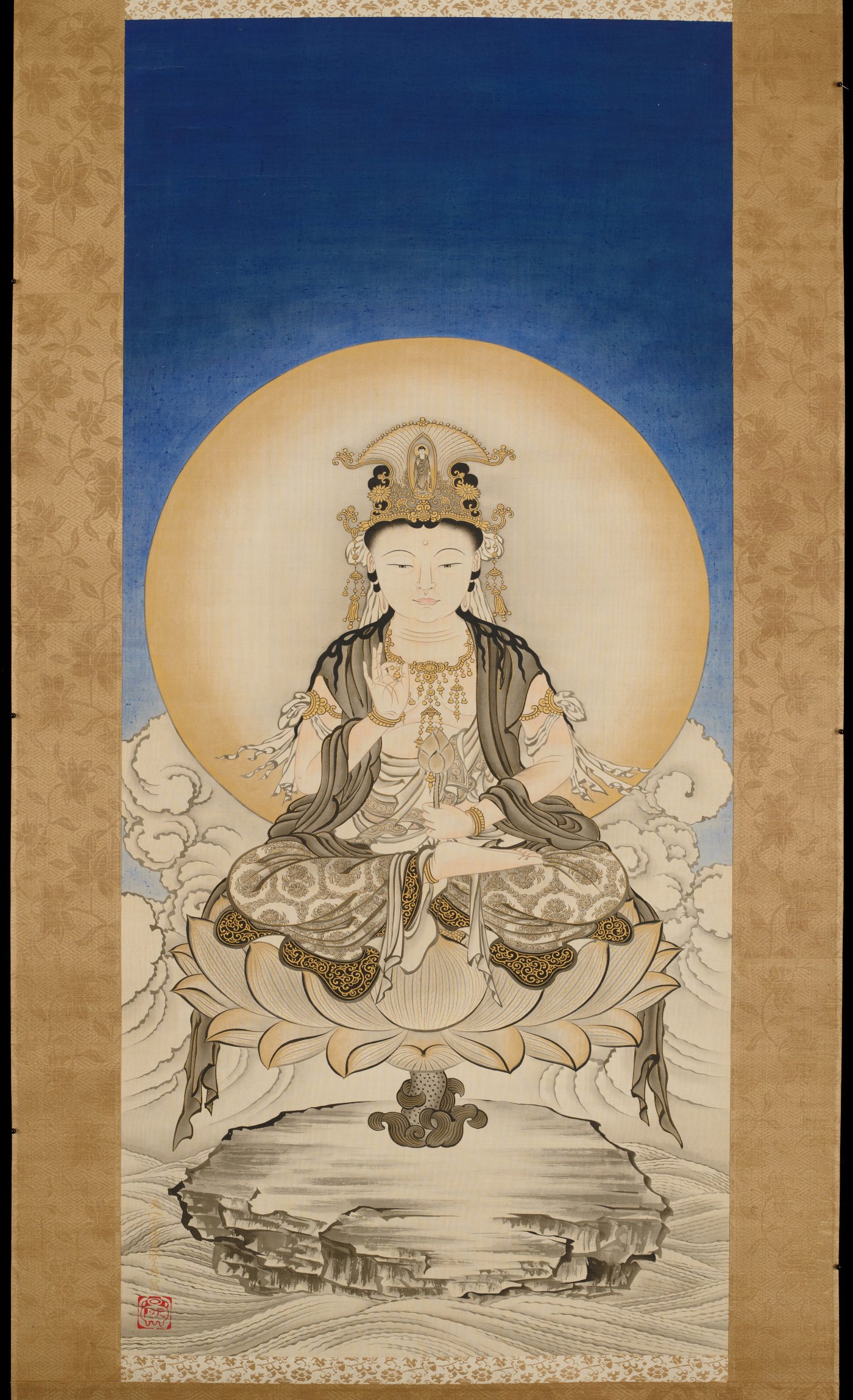
Guānyīn Púsà Pǔ mén pǐn Xuán yì/ Kannon Bosatsu Fumonbon Gengi
The Profound Meaning of the Universal Gate of Avalokiteśvara 觀音菩薩普門品玄義 is one of a series of ‘Profound Meaning’ (玄義) texts attributed to Zhiyi, a model established by his famous ‘Profound Meaning of the Lotus Sūtra (法華玄義, T 1716).
These ‘profound meaning’ commentaries do not offer a line by line interpretation of a sūtra, instead they offer a broad systematic introduction to the meaning, purpose and structure of the sūtra. It was believed to have been lectured by Zhiyi towards the end of his life, and written down by his disciple Guanding (灌頂).
Zhiyi based his commentary on Kumārajīva’s translation of the Lotus Sūtra (T262). The English version of this sūtra was translated by the BDK (Bukkyo Dendo Kyokai) and can be downloaded for free from their website.
STRUCTURE
The structure of this commentary follows the framework of Profound Meaning of the Lotus Sūtra by using the “Fivefold Profound Meaning” framework (五重玄義, wǔchóng xuányì)
- Name (名) – Analysis of the title
- Substance/essence (體) – The ‘True Nature’ (法體) that is revealed by the Sutra
- Gist/significance (宗) – The essential message (宗旨)
- Teaching (教) – The doctrinal classification (教相) of the sutra
- Function (用) – The “benefits” of the sutra
1. Explaining the Title (釋題)
Zhiyi goes into detail on the title of this Chapter, which is “the Universal Gate of Avalokiteśvara” As previously stated, Kumārajīva’s translated the name of Avalokiteśvara into Chinese as 觀世音 Guānshìyīn/Kanzeon (‘Lord who looks upon sound [of the world]’). Zhiyi states that the transliteration of the full Sanskrit name Āryāvalokiteśvara (Noble Avalokiteśvara) would be pronounced Āyépólóujídīshū / Ānàpóluójiédīshū (阿耶婆婁吉低輸) in Chinese. However, Zhiyi bases his analysis on the Chinese translation of 觀世音 Guānshìyīn, not the transliteration.
He starts with a General Explanation (通釋) which focuses on the both the person (Avalokiteśvara) and the Dharma (Universal Gate, ‘Sarvadvāra’), and then further elaborates with a Specific Explanation (別釋) which looks at these elements separately.
a. General Explanation (總釋)
On the name Guānshìyīn 觀世音
- Guān/Kan ‘觀’ – In Chinese means to contemplate, perceive, look, observe, etc. According to Zhiyi this represents the function of wisdom (境智雙舉, both subject and object are raised together)
- Shìyīn/Ze-on ‘世音’ – In Chinese means, roughly, sounds of the world. The sounds of the world are the cries or pleas of sentient beings, which represents the object of contemplation (所觀之境)
Thus, the name of Avalokiteśvara embodies both wisdom (Guān/Kan ‘觀’) and compassion (Shìyīn/Ze-on ‘世音’)
On the “Universal Gate” 普門 (Pǔ mén/Fumon)
- Pǔ/Fu ‘普’ – In Chinese means ‘universal’. This represents the ability to pervade everywhere
- Mén/Mon ‘門’ – In Chinese means ‘gate’ and represents the ability to penetrate
Thus, ‘Universal’ gate represents the Avalokiteśvara’s ability to pervade everywhere and opens the Ten Universal Gates (十普門) without obstruction, which is Avalokiteśvara’s one true characteristic (一實相)
Ten Universal Gates (十普門);
- Universal Gate of Compassion (慈悲普) – The bodhisattva’s compassion extends to all beings without discrimination
- Universal Gate of Great Vows (弘誓普) – Vows to liberate all sentient beings
- Universal Gate of Practice (修行普) – Enabling all beings to practice and achieve realization
- Universal Gate of Eliminating Delusions (斷惑普) – Cutting through confusion and ignorance
- Universal Gate of Entering the Dharma (入法門普) – Entering into the teachings
- Universal Gate of Supernatural Powers (神通普) – Manifesting spiritual powers
- Universal Gate of Skillful Means (方便普) – Using expedient methods to help beings
- Universal Gate of Teaching the Dharma (說法普) – Teaching the Dharma universally
- Universal Gate of Accomplishing Sentient Beings (成就眾生普) – Helping all beings achieve spiritual realization
- Universal Gate of Making Offerings to All Buddhas (供養諸佛普) – Making offerings to all Buddhas
b. Specific Explanation (別釋)
i. Ten Keys/Significances (十義)
Zhiyi introduces the Ten Keys/Significances (十義) which map Avalokiteśvara’s functions across compassion, wisdom, skillful means, and soteriology.
- Person and Dharma (人法) – ‘Person’ means Avalokiteśvara as a bodhisattva – the compassionate subject who practices. ‘Dharma’ means Universal Gate – representing Dharma as object. Together they show that practice requires both subject (person) and object (dharma).
- Compassion (慈悲) – The Chinese is made up of two words, which are translations of the Sanskrit ‘maitrī’(慈) and ‘karuṇā’ (悲). Maitrī means to bring happiness. Karuṇā means to remove suffering. Zhiyi emphasises that compassion is not passive, but active and reinforced by our vows. Our vows are the foundation of compassion, without which, our compassion could crumble. Due to his great vows, Avalokiteśvara embodies compassion.
- Merit and Wisdom (福慧) – Merit (福 – puṇya) and wisdom (慧 – Prajñā) comes from the practice of the Six Perfections. They are like the two wheels of a cart in that they must function together. Merit without wisdom brings about blind concentration. Wisdom without merit brings about “wild wisdom” (arrogance). Avalokiteśvara manifests as both.
- Truth and Responsive manifestations (真應) – “True” manifestation refers to the Dharmakāya (法身), the reality body, unmoving and beyond illusion. “Responsive” manifestation refers to the Nirmāṇakāya (應身), which manifests according to conditions. Like a mirror that naturally reflects images, Avalokiteśvara operates through both simultaneously.
- Medicine and wish fulfilling jewel (藥珠) – Medicine heals the afflictions (kleśa) of sentient beings. The Wish Fulfilling Jewel (cintāmaṇi) grants wishes. Avalokiteśvara is said to both heal and grant wishes, symbolising the two forms of compassion bringing happiness and removing suffering.
- Hidden and manifest benefits (冥顯) – The ‘hidden’ benefits are inconceivable. The ‘manifest’ benefits are direct/manifest activities. Avalokiteśvara carries out both as unseen protection (against disasters, for example), and manifests through visible forms that interact with sentient beings.
- Provisional and real (權實) – ‘Provisional’ is upāya, using skilful means to adapt to sentient beings capacities and capabilities. ‘Real’ is the Truth (真實) – i.e., the Dharma free from delusions. An upāya is Avalokiteśvara appearing as a deity. The real is Avalokiteśvara teaching ultimate truth. This mirrors the Lotus Sūtra that ‘opens the provisional to reaveal the real’ (開權顯實).
- Origin and trace manifestations (本迹) – The ‘origin’ is the eternal, fundamental reality, which is Avalokiteśvara’s inherent dharmakaya. The ‘trace’ are the temporal manifestations (such as the 33 manifestations). Avalokiteśvara utilises both, as without ‘origin’ there would be a lack of foundation. Without ‘traces’ there’d be a lack of origin. This teaching relates back to Zhiyi’s commentary of the Lotus Sūtra in which he splits the text into two main sections, the ‘trace’ teachings and ‘origin’ teachings.
- Conditioned and complete causes (緣了) – ‘Conditioned causes’ are things such as merit and produces compassion. ‘Complete causes’ are what is directly realised through wisdom (prajñā). Merit and Wisdom together yield Buddhahood. Avalokiteśvara embodies both, uniting wisdom and compassion as the seeds for awakening.
- Wisdom and cutting off afflictions (智斷) – ‘Wisdom’ 智 here refers to higher knowledge, or Jñāna, aka ‘luminous knowledge. This is ‘true knowledge of reality. ‘Cutting off afflictions’ or ‘Prahāṇa’ means to abandon, relinquish, wrong views (mithyādṛṣṭi) and afflictions (kleśas). This is freedom from afflictions. Avalokiteśvara exemplifies these two fruits of the path. These relate to the Three Virtues (三德) of Buddhahood, Dharmakāya Virtue (ultimate reality, the true nature of all phenomena), Prajñā Virtue (perfect wisdom that allows a Buddha to perceive the true nature of reality – dharmatā), and Mokṣa Virtue (liberation – complete freedom from attachments and defilements).
ii. Five Periods Eight Teachings (五時八教)
Zhiyi uses his classification of Buddhist Doctrine, known as the Five Periods Eight Teachings 五時八教, in his interpretation of this chapter, linking them to the 10 Keys/Significances. This hermeneutical and pedagogical approach provided a helpful framework in which to understand how the numerous different Buddhist teachings relate to each other. The Eight Teachings are split into two subcategories; Fourfold Teachings of Transformation 化法四教, and the Fourfold Method 化儀四教.
- Avataṃsaka Period 華嚴時 – Zhiyi considered the Avataṃsaka Sūtra to be the very first teaching of Shakyamuni after his Nirvana. This is because it is an indepth and robust teaching on the Bodhisattva path and the attainment of Anuttarā Samyak Sambodhi 阿耨多罗三藐三菩提 (Full Complete Buddhahood). This Sūtra and Period of the Buddha’s teaching illustrates “Person & Dharma” (人法), Compassion (慈悲), Merit & Wisdom (福慧), and “Truth/Responsive Bodies” (真應), and hints at “Medicine & wish fulfilling jewel” (藥珠), and “Hidden & Manifest benefits” (冥顯). However, it lacks the “Provisional & Real” (權實), the “Origin & Trace manifestations” (本迹), the “Conditioned & Complete causes” (緣了), and “Wisdom & Cutting off afflictions” (智斷). This is because, despite the grand vision of the Avataṃsaka Sūtra it does not reveal the Buddha’s skilful provisional means nor his eternal origin. The Avataṃsaka Sūtra/Period is classed as a“Distinct Teaching” 別教.
- Āgama or Deer Park Period 鹿苑時 – After teaching the Avataṃsaka Sūtra for 21 days, according to Zhiyi the Buddha changed tactics and began preaching to śrāvakas and pratyekabuddhas for 12 years. The teachings in the Āgama Tripiṭaka (Tripiṭaka Teaching, 三藏教 – parallels wtih the Pali Nikayas) emphasises renunciation, importance, dependant origination, and nirvāṇa as cessation. However, unlike the vastness of the Avataṃsaka Sūtra, the Āgama Tripiṭaka only covers “Person & Dharma” (人法), Compassion (慈悲), and Merit & Wisdom (福慧). It does not illustrate Avalokiteśvara’s universal salvific functions. The Āgama or Deer Park Period is classified as the “Tripitaka Teaching” 三藏教.
- Vaipulya Period 方等時 – According to Zhiyi, for 8 years the Buddha expanded on the Āgamas, delivering “expanded” (Vaipūlya) teachings, or what we’d classify as Mahāyāna. This marked a transitional stage in the Buddha’s teachings, and includes keys/significances 1 through to 6 (Hidden and manifest benefits 冥顯). The Vaipulya Period is classified as a “Shared Teaching” 通教.
- Prajñaparamita Period 般若時 – According to Zhiyi, the Buddha then taught the Prajñaparamita Sūtras for 22 years. These sūtras emphasise the wisdom (prajñā) of emptiness (śūnyatā) and are fully Mahāyāna. However, it only includes 1-8 of the keys/significances. The Prajñaparamita Period is also classified as a “Shared Teaching” 通教
- Lotus and Nirvana Period 法華涅槃時 – According to Zhiyi, the final period is when the Buddha taught the Lotus Sūtra and (Mahāyāna) Nirvana Sūtra. These sūtras contain all 10 of the keys/significances, revealing the true intent of the Buddha, the One Vehicle (Ekayāna 一佛乘), and the true nature of the eternal Buddha. The Lotus and Nirvana period is classified as the “Complete (Round) Teaching” 圓教
2. Identifying the Essence (釋題)
The first section (title 釋題/name 名) describes who Avalokiteśvara is. The essence 體 describes the principle reality that Avalokiteśvara embodies, which is the reality of the Middle Way.
a. Avalokiteśvara’s relationship with the Three Truths (三諦)
Its important that we embody the middle way in our practice; with too much focus on emptiness we fall into nihilism. With too much focus on provisional existence, we cling to phenomena. These must be kept in balance. Emptiness is the wisdom of seeing all dharmas as empty. Compassion is manifesting in a myriad of forms to alleviate suffering. Avalokiteśvara embodies both wisdom and compassion, thus Avalokiteśvara embodies the Middle Way. How can Avalokiteśvara be two things at once? Zhiyi likened this to the ocean and waves, in that they are distinct in name only, which we designate to differentiate according to appearances. The ‘waves’ are like the 33 forms of Avalokiteśvara that appear to save sentient beings. But all of these forms are not separate from the Dharmadhātu (法界), the Middle Truth, just like the waves are not separate from the ocean.
b. Distinction between ‘essence of person’ and ‘essence of Dharma’
This distinction is subtle;
- Essence of the Person – as a Bodhisattva Mahasattva, Avalokiteśvara exemplifies wisdom and compassion, uniting the two as the Middle Truth. In other words, Avalokiteśvara represents the Three Truths.
- Essence of the Dharma – the Universal Gate represents the Threefold Contemplation in One Mind 一心三觀. In other words, the Universal Gate represents the Three Truths in a single thought.
c. Contemplating sound
As we have seen, the name of Avalokiteśvara is closely related to hearing sounds. The Chinese name Guānyīn 觀音 contains ‘look’ 觀 and ‘sound’ 音. ‘Look’ 觀 is also another word for the practice of meditative contemplation, thus we can say that Avalokiteśvara is the contemplator of sounds. Thus, Avalokiteśvara’s essence can be realised through the contemplation of sound.
When we hear sounds we should contemplate the sound as empty.
After realising sound as empty, we should generate compassion by contemplating the provisional existence of sound as the anguish of suffering.
Integrating the two, we should contemplate sound as the Middle – both empty and provisional.
Avalokiteśvara’s salvific act of listening is equal to the meditative realisation of the Middle Truth. Thus, “hearing” (which is the function of Avalokiteśvara’s compassion) is equal to liberation itself. The Universal Gate is universal because it pervades all aspects of being without obstruction.
(See Five Views & Five Sounds of Avalokiteśvara.)
3. Clarifying the Gist/Significance (明宗)
In the third section of Zhiyi’s commentary, we come to the ‘zōng’ 宗, meaning ‘gist’ or ‘significance’. According to Zhiyi, this is the core intention or driving purpose of any given text. It’s reason for being.
It should be noted that although we speak about the ‘essence’ and the ‘gist’ as two different subjects, they are in fact of one nature. The ‘essence’ is conceptual, and the ‘gist’ is the practice application of the ‘essence’.
a. Liberation of all Sentient Beings
It cannot be emphasized enough, that the main aim of this text is the universal liberation of all sentient beings. Avalokiteśvara’s Great Compassion is without conditions, and a function of wisdom. Compassion and wisdom are the vehicles for liberation.
b. Two Kinds of Compassion
According to Zhiyi, Avalokiteśvara embodies two different types of compassion;
- Conditioned compassion (有緣慈悲) – conditioned compassion does not refer to the withholding of compassion for some people, it means using skilful means to adapt compassion to the various conditions and circumstances, much like a doctor will tailor the medicine for the individual.
- Unconditioned compassion (無緣大悲) – Unconditional compassion arises spontaneously without any thought of self or other. It flows naturally from the realisation of emptiness and corresponds to the Middle Truth.
c. Three types of Compassion & Three Truths
Avalokiteśvara utilizes three types of compassion simultaneously;
- Arising & ceasing compassion 生滅悲 – in relation to birth & death, and dualism (cause of suffering & end of suffering). This type of compassion is associated with the truth of the provisional
- Non-arising compassion 無生悲 – compassion that is grounded in emptiness and non-duality. This type of compassion is associated with the truth of emptiness.
- Non-conditional compassion 無緣悲 – this compassion arises spontaneously, without marks. It is associated with the truth of the Middle.
d. Four Great Vows 四弘誓願
Zhiyi illustrates how the main aim of this chapter of the Lotus Sūtra can be linked with the main aim of the Four Bodhisattva Vows, which is also Avalokiteśvara’s main purpose;
- Sentient beings are numberless, I vow to save them all – illustrates compassion
- Afflictions are inexhaustible, I vow to end them all – illustrates wisdom
- Schools and traditions are manifold, I vow to study them all – the schools and traditions are the upāya dharma gates (expressions of skilful means)
- The Buddha way is Supreme, I vow to complete it – the ultimate aim of this chapter is for sentient beings to attain enlightened, through the unification of compassion and wisdom.
e. Contemplation and Response
In the Makashikan 摩訶止觀, Zhiyi distinguishes the ‘gate of contemplation’ 觀門 vs the ‘gate of response’ 應門. In commenting on this chapter, Zhiyi uses these two to describe both Avalokiteśvara’s and our own practice as ‘inner contemplation’ 內觀 and ‘outer response’ 外應;
- Inner contemplation 內觀 – This is the practice of contemplating sound as empty, provisional and the Middle, and corresponds to the Gate of Contemplation 觀門
- Outer response 外應 – The 33 manifestations of Avalokiteśvara is an example of the Gate of Response 應門
In commentary, Zhanran said “The contemplation gate reveals the principle. The response gate reveals phenomena. Principle of phenomena are non-obstructive, one essence with two functions.” 觀門顯理,應門顯事,理事無礙,一體兩用。
f. The Universal Gate 普門 as the Gist
The Universal Gate as mentioned in the title of this chapter can be understood in two ways;
- Universal among all beings – Avalokiteśvara works for all sentient beings in all realms. This is universality among all beings
- Universal through the Dharmadhātu – The Middle Truth pervades all phenomena, thus every gate is the Universal Gate.
“Like a bright mirror in which all images appear; through the twin illumination of compassion and wisdom, the Universal Gate is one.” 譬如明鏡,眾像現中;悲智雙照,普門一如。
4. Explaining the Function (辯用)
The ‘function’ 用 of chapter 25 (“Universal Gateway of the Bodhisattva Perceiver of the World’s Sounds”), is the application of the ‘Essence’ 體.
a. Unifying ‘function’ and ‘essence’
- ‘Essence’ is the reality of the Middle Way
- ‘Function’ is then saving sentient beings through Great Compassion
Like wisdom and compassion, contemplation and response, the ‘essence’ and ‘function’ are non-dual.
b. Two types of Function
Zhiyi explains Avalokiteśvara’s function in two ways; inner and outer function. Although we can describe them separately they are in fact inseparable. The ‘inner’ contemplation gives rise to the ‘outer’ response. Responding to others deepens contemplation.
- Inner Function – The contemplative function of the Three Truths and the realisation of compassion through the means of perceiving sounds, corresponding to wisdom.
- Outer Function – The manifestation of 33 forms to save sentient beings according to their needs, corresponding to upāya and compassion.
c. Thirty Three Manifestations of Avalokiteśvara
The Chapter 25, we have the famous Thirty Three Manifestations of Avalokiteśvara. Zhiyi interprets these not just literally but also as symbolically representing the limitless adaptability of compassion in action.
- Thirty Three Bodies in the Three Worlds 三世間 – The Three Worlds, also known as the Three Realms of Existence, comes from the Mahāprajñāpāramitā śāstra (‘The Treatise on the Great Perfection of Wisdom 大智度論).
In the ‘World of Aggregates’ 五陰世間 Avalokiteśvara appears as figures such as an Arhat, or Brahmā, etc, teaching the emptiness of aggregates.
In the ‘World of Sentient Beings’ 眾生世間 Avalokiteśvara appears as figures such as lay men, lay women, or deities, etc, responding to the emotional and moral needs of sentient beings.
In the ‘World of Lands/Realms’ 國土世間 Avalokiteśvara manifests in various Pure Lands, or as voices, sounds, lights, etc, transforming the environment and harmonising worlds. - Thirty Three as a symbolic number – in this case, thirty three is a provisional number, and in fact, there is no limit in which the compassion and wisdom of Avalokiteśvara appears.
d. Two kinds of Benefits
Zhiyi identifies two kinds of benefits of the function of Avalokiteśvara’s compassion. As before, although we speak of two, they are in fact indivisible.
- Hidden benefits 冥益– Unseen protection from things such as natural disasters, etc.
- Manifest benefits 顯益 – Direct and/or visible benefits, such as saving beings from fire, etc
e. Hearing the name as Liberation
When contemplating hearing we can realise the emptiness of sound. Compassion can turn delusions into the sound of wisdom (dharma). And so, hearing the name of Avalokiteśvara becomes an act of contemplation and thus liberation. Upon hearing the name, we become part of Avalokiteśvara’s function.
f. Universal Gate as Function
Avalokiteśvara’s adaptability, or universality, is the reason this chapter is called the ‘Universal Gate’ 普門. Zhiyi relates this to the ‘One Buddha Vehicle’ 一佛乗 (Ekayāna 一乗) and so calls it the ‘One Gate’ 一門. The Middle Truth is the ‘One Gate’. Great Compassion is the ‘universal response’ for all sentient beings.
5. Classifying the Teachings (教相)
The fifth and final layer of this commentary places this chapter within the classical Tiantai classification system (panjioa 判教) of the Five Periods and Eight Teachings 五時八教 (as previously covered). Zhiyi emphasises that the Universal Gate Chapter of the Lotus Sūtra is the ‘Function Gate of the Perfect Teaching’. Within the Lotus Sūtra itself, the Chapter of Skilful Means reveals the One Vehicle (一乘), Lifespan Chapter reveals the Eternal Buddha (本佛常住), and the Universal Gate Chapter reveals the function of universal compassion (大悲用門). Therefore, this chapter is the ‘manifest function’ of the whole Lotus Sūtra, as it demonstrates the truth of the One Vehicle through compassion and wisdom.
Finally, Zhiyi finishes by stating that the Nirvana Sūtra serves as an epilogue to the Lotus Sūtra, ensuring that beings of lesser capacities are able to grasp the perfect truth.
 Tendai Buddhism UK