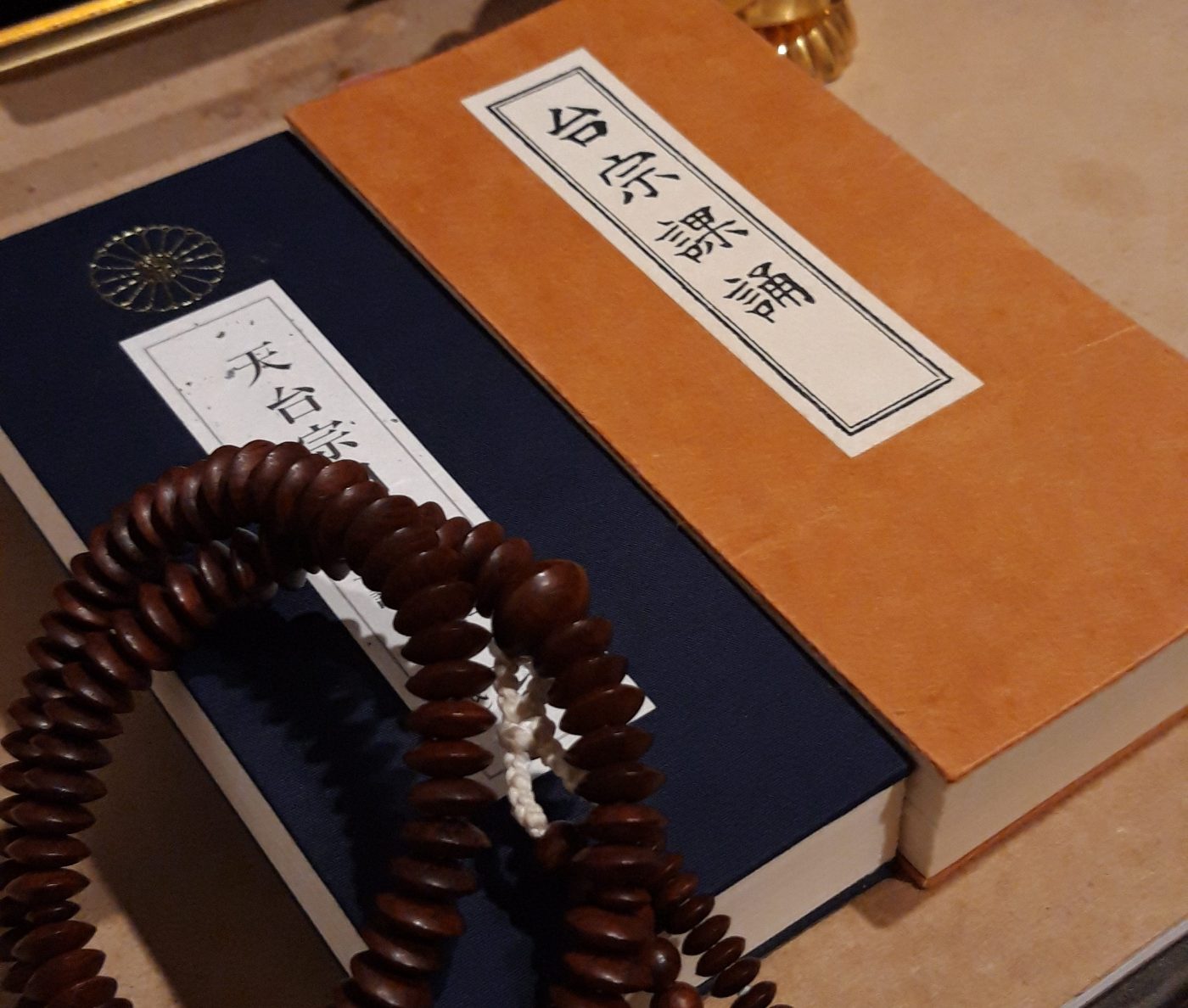
Gongyō 勤行 (Diligent/assiduous practice)
Gongyō is the regular recitation of the Buddha’s teachings and other such practices. It is also known as O-tsutome お勤め, meaning ‘to carry out ones work/duty/business’. Although often called ‘pūjā’ (meaning praise or worship), the gongyō of Tendai Buddhism (and others) is actually based around the repentance practices of our Chinese lineage ancestors. That’s not to say that pūjā, or praise, doesn’t exist in Tendai.
Sanrai 三禮 (Three Courtesies/bows)
(Also 三礼) The exact origins of this verse are unknown, but can be found in the ‘Ritual for veneration of the Dharma Flower Sutra’ 禮法華經儀式 (Rei Hokke kyō gishiki礼法華経儀式). Variations of this verse are then found in texts such as ‘Lotus Repentance Ritual’ (Hokke Senbo 法華懺法), the ‘Lotus Samādhi Repentance Ritual’ (Hokke Sanmai Gi 法華三昧儀), and the ‘Golden Light Sutra Repentance Ritual’ (Konkomyo Senbo 金光明懺法), all of which suggests the verse possibly originated with Master Zhiyi or Master Huisi.
Sangemon 懺悔文 (Verse of repentance/confession)
The Sangemon is taken from the verse at end of Chapter 39 of the Avataṃsaka Sūtra. This specific chapter is also known as the Gandavyūha Sūtra.
Sanki Sankyō 三帰三竟 (Three refuges – three verses)
The Sanki Sankyō verse is taken from the Avataṃsaka Sūtra, chapter 11. Whilst Sanrai is a verse of veneration, this verse contains the act of taking refuge in the Buddha, Dharma and Sangha. This ritual is the primary act of all Buddhists of all denomitations.
Kaikyōge 開経偈 (Opening Sutra verse)
The Kaikyōge is a verse of mindfulness (gatha 偈文) usually recited before opening a sutra. The author of the verse is uncertain, however it is believed that it originated in China. According to one story, in the Tang dynasty, Empress Wu (Wu Zetian武則天) invited the two famous monks 神秀 Jinshū and 慧能 Enō to Chang’an (Xi’an). When they arrived, to articulate her awe of meeting the two, she recited the now famous verse. In another story, the verse was written by Shikshananda (Jisshananda 実叉難陀 652–710) as a preface to his translation of the Flower Garland Sutra (Kegon-gyo 華厳経), at the request of Empress Wu. There are also other stories and theories.
Jū nyōze 十如是 (Ten Thusness’s)
A teaching on the Ten Thusness’s/Suchness’s, this verse is taken directly from chapter 2 of the Lotus Sutra, as translated into Chinese from Sanskrit by Kumārajīva. BDK version, page 28, first paragraph.
Enmei jukku kannon gyō 延命十句観音経 (Life-Extending Ten-Line Kannon Sutra)
The Enmei jukku kannon gyō is understood to be a summary of the (slightly longer) Kōō Kanzeon gyō 高王観世音経, so called due to its connection with Emperor Gao Huan 高歓 (496 – 547AD). This sutra is also considered to be a summary of Chapter 25 of the Lotus Sutra.
The earliest record of the Enmei jukku kannon gyō is from a book called Busso-tōki 仏祖統紀 (Fo-tsu-t’ung-chi) “The Record of the Lineage of the Buddha and the Patriarchs”, written in 1269CE by the Tiantai monk Chih-p’an 志磐 (Shiban). The book contains the transmission of the Dharma from the Buddha, through Indian and Chinese patriarchs, according to the Tiantai school.
On scroll number 36, “27th Year of the reign Yuanjia 元嘉, Lui Song Dynasty 劉宋 (450CE)” a military commander, Ōgenbō 王玄謨 failed to conquer the north. On the eve before being executed he had a dream that told him “if you recite the Kannon Gyō 観音経 a thousand times you’ll escape your sentence. Ōgenbō did as he was instructed in the dream, and the next day was spared execution. The Kannon Gyō in this story is not the same as the chapter found in the Lotus Sutra 法華経, but the Enmei jukku kannon gyō.
Scroll number 37 (of the same text) contains a similar story of a person called Son Keitoku 孫敬德 (Sun Jingde), incarcerated for a crime he didn’t commit during the Eastern Wei dynasty (534-550). While on death row, he recited the 25th Chapter of the Lotus Sutra continuously awaiting his execution. One night he had a dream of a monk who taught him the Kōō Kanzeon gyō. Waking from his dream, he immediately recited the sutra without making a mistake. As dawn broke he was taken to be executed, still chanting the sutra. But when the executioner brought his sword down, it broke into pieces. He tried a second sword but that too broke. Because of this miraculous event, the Emperor granted Son a special pardon and was acquitted.
In another story on scroll number 53 (same text), a woman loses her sight and is in despair. A person appears to her in a dream and tells her to recite the Kannon Gyō. After doing so her sight is restored.
Ekō 回向 aka Hokke Jōbutsu Ge 法華成佛偈 (Transference of Merit/Attaining Enlightenment Through the Lotus Sutra)
The ekō (Pariṇāmanā) comes directly from the Lotus Sutra as translated from Sanskrit into Chinese by Kumārajīva, chapter 7. In the BDK version of the text, it is at the bottom of page 136.
Shichi Butsu Tsu Kai Ge 七佛通戒偈 (The verse of the commandment commonly taught by the Seven Buddhas of the past)
A universal verse that can be found in numerous texts and sutras across all traditions, such as the Pali Dhammapada, the Chinese Si Fen Lu (Vinaya in Four Divisions), numerous Ekottarāgama (such as T.2, 551a13-14) etc. The seven Buddhas referenced are the named Seven Buddhas of the past, with Shakyamuni being the 7th.
In Sanskrit; sarva pāpasya akaraṇaṃ, kuśalasya upasaṃpadaḥ; sucitta paryavadānam, etad buddhasya śāsanam.
Endonsho 圓頓章 (Perfect Sudden Enlightenment)
The Endonsho is almost entirely taken directly from the Maka Shikan (摩訶止観 Mohe chihquan), written by Master Zhiyi, with the acceptation of the last verse (to chi shin do), which is taken from Master Zhanran’s commentary.
Shariraimon 舎利礼文 (Verse honouring the relics of the Buddha)
It is believed this verse originates from India and was brought to China by the Vajra master Amoghavajra 不空金剛 (Fukū Kongo 705–774). The title of the text derives from the Sanskrit Hybrid word Śarīra meaning ‘relic’, deriving from the original Sanskrit term Śarīraḥ, meaning ‘body’. Śarīra can also refer to Dharmakāya śarīra, or sutras that were taught by the Dharmakāya. The relics themselves are typically pearl-like solids left over after the body of an emanant monastic, Bodhisattva or Buddha is cremated. These relics are considered to emanate adhiṣṭhāna (blessing) to those who pay respects to them. They are also believed to ward off evil. Relics are typically stored in stupas.
Hongakusan 本覚讃 (Original Enlightenment Praise)
This verse is an extract from the Myōhō renge zanmai himitsu sanmaya kyō 妙法蓮華三昧秘密三昧耶経 (Sūtra of the secret samaya (symbols) of the samādhi of the lotus blossom of the Wonderful Dharma), or Renge sanmai Kyō for short. It is an esoteric text said to have been brought back from China by Enchin and translated from Sanskrit by Amoghavajra. However, it is now known to have been written in Japan around Annen’s time (841–889), possibly even written by Annen 安然 himself, although Annen claims this text was brough back from China by Kūkai. These days, only this extract is recited. The sutra asserts the unity of the Womb and Diamond Realms through an esoteric interpretation of the Lotus Sutra.
Kangyomon 觀經文 (Contemplation sutra verse)
A short verse taken from the Contemplation on the Buddha of Immeasurable Life Sūtra (Kanmuryoju Kyō, or Kangyō for short).
Nembutsu ekōge 念仏回向偈 (Mindfulness of the Buddha Merit Transference verse)
This verse is found in the Longer Sukhāvatīvyūha Sūtra (Daimuryōju kyō 大無量寿経)
 Tendai Buddhism UK