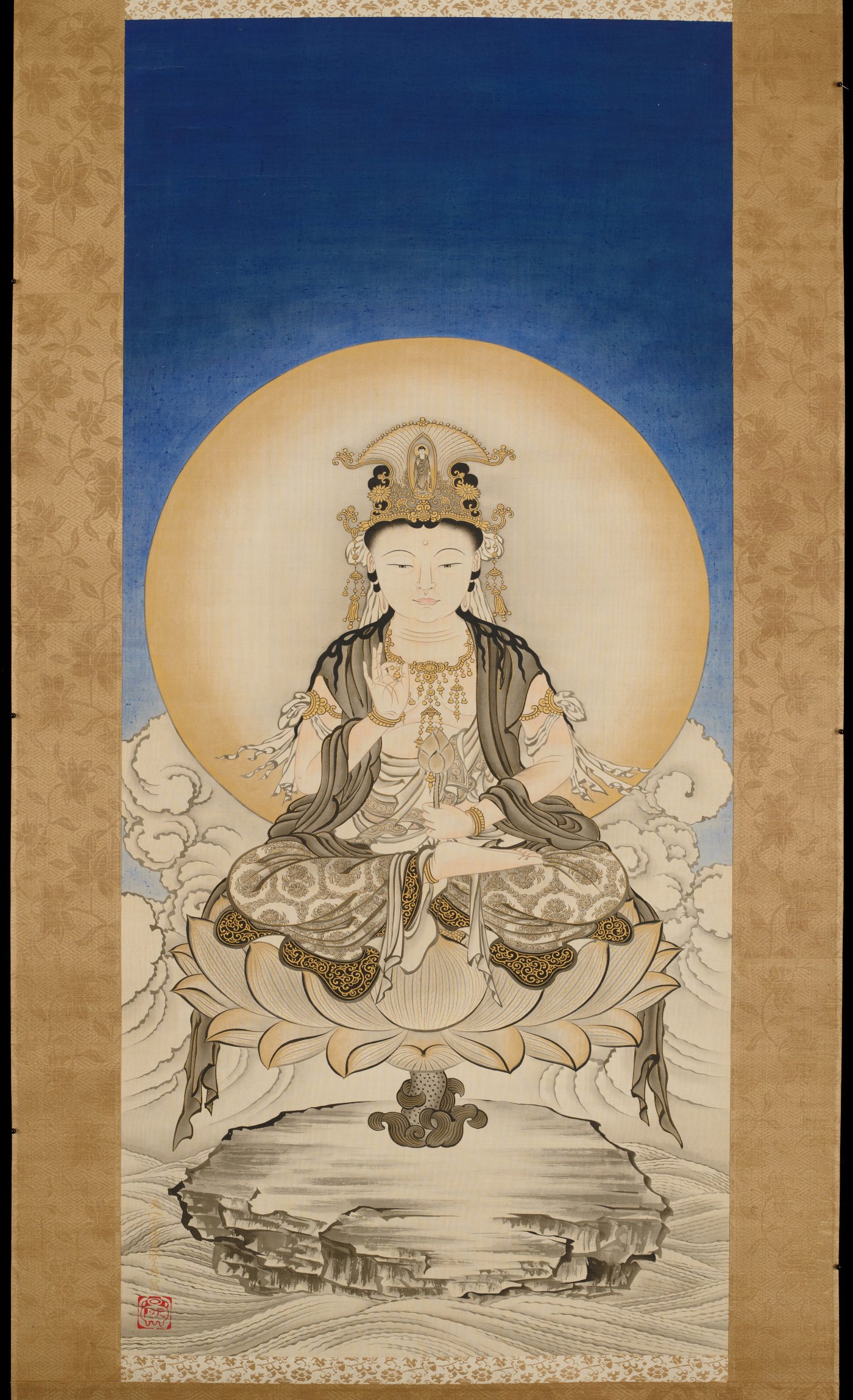
Introduction
Disclaimer: I am not a teacher, not an Ajari, not a scholar and not a historian. The following is a teaching based on a classic view of the Lotus Sutra.
This is a teaching stemming from the verse section of chapter 25 of the Lotus Sūtra, also known as the Avalokiteśvara Sūtra (Kannon Kyō). This verse/sūtra is popularly chanted in Tendai, Nichiren, Zen, Shingon, and many others.
Five Views 観音様の五観
The Five Views comes from this section of the Lotus Sūtra;
真観清浄観 広大智慧観 悲観及慈観 常願常瞻仰
無垢清浄光 慧日破諸闇 能伏災風火 普明照世間
悲体戒雷震 慈意妙大雲 樹甘露法雨 滅除煩悩炎
諍訟経官処 怖畏軍陣中 念彼観音力 衆怨悉退散
In English;
“He of the true gaze, the pure gaze, the gaze of great and encompassing wisdom, the gaze of pity, the gaze of compassion— constantly we implore him, constantly look up in reverence. His pure light, free of blemish, is a sun of wisdom dispelling all darknesses. He can quell the wind and fire of misfortune and everywhere bring light to the world. The precepts from his compassionate body shake us like thunder, the wonder of his pitying mind is like a great cloud. He sends down the sweet dew, the Dharma rain, to quench the flames of earthly desires. When law suits bring you before the officials, when terrified in the midst of an army, think on the power of that Perceiver of Sounds and hatred in all its forms will be dispelled.”
Lotus Sūtra, Chapter 25, Burton Watson
“He who perceives the world with truth, purity, And vast knowledge, And with benevolence and compassion, Should be ever longed for and looked up to. He is a spotless pure ray of light, A sun of wisdom that destroys the darkness, A flame that withstands the winds of calamity. He brilliantly illuminates the entire world. His will, the essence of which is compassion, Shakes like thunder; And the mind of mercy Is like a beautiful overspreading cloud, Which pours the Dharma rain of immortality And extinguishes the flame of desires. In a dispute before judges, Or fearful in the midst of battle, If you contemplate the power of Avalokiteśvara, All enemies will flee away.”
Lotus Sūtra, Chapter 25, BDK
Explanation;
真観清浄観 広大智慧観 悲観及慈観
真観 Shinkan – True view/contemplation
清浄観 Shōjōkan – Purity view/contemplation
広大智慧観 Kōdaichiekan – Vast wisdom view/contemplation
悲観 Ihikan – Benevolence view/contemplation
慈観 Jikan – Compassion view/contemplation
These five do not describe meditations per se, but describes Avalokiteśvara’s own practice and outlook. It is not only how he views the world but also something we should emulate in our own practice.
In Chinese, Avalokiteśvara’s name is 觀世音 Guānshìyīn and 觀自在 Guānzìzài meaning, “who perceives the world’s lamentations” and “who looks down upon sound” respectively (Kanzeon & Kanjizai in Japanese). 觀 Guān/Kan means to view/to look, and refers both to his act of looking upon the world, and also describes his ability to see reality as it is. 觀 Guān/Kan is also used as a translation for the Sanskrit vipaśyanā which refers to insight into the true nature of reality.
1. 真観 Shinkan
True view/contemplation means to view the true nature of reality. On a mundane level it can mean to discern the good from the bad, the right from the wrong. From the view of emptiness, there is neither good nor bad. For Tendai Buddhists, the view of the Middle is the ultimate, and means to view the true nature of reality just as it is.
This view can be seen in the practices of contemplating the Three Truths (三諦観), contemplating Suchness (真如観) and Contemplating Three Thousand Realms in a Single Thought Moment (一念三千観).
2. 清浄観 Shōjōkan
Purity view/contemplation means to purify the mind of attachments and the kleshas. 清浄 Shōjō can mean ‘to be pure, untainted’, or it can refer to a state of mind that is free from worldly desires. Before we begin our daily practice we first purify ourselves by washing our hands, mouth, and donning clean clothing. Perhaps we use a phrase, or mantra to purify ourselves. We clean the temple, our homes, or our place of practice, keeping it neat and tidy. The practice of the precepts is concerned with purifying our bodies, speech and mind. In Sanskrit we might refer to this as ‘śuddhi’, which can mean ‘purity, holiness, cleanness’, etc. Or we could refer to ‘viśuddhi’ which means the practice of purification. In Upatissa’s Vimutti-Magga (The Path To Freedom, 解脫道論), there are Seven stages of Purification (satta-visuddhi);
- Purification of morality (sila-visuddhi)
- Following (monastic) vows (pātimokkhasamvara-sīla)
- Restraining senses (indriysamvara-sīla)
- Pure livelihood (ājīvapārisuddhi-sīla)
- Four Requisites (paccaya-sannissita-sīla)
- Monastics – robes, almsfood, dwelling, and medicine
- Purification of mind (citta-visuddhi)
- Eight Dhyānas (four form, four formless)
- Access concentration (upacāra-samādhi)
- Purification of view (ditthi-visuddhi)
- Reality of mind
- Truth of reality
- Overcoming view of ‘self’
- Purification by overcoming doubt (kankhā-vitarana-visuddhi)
- Understanding the origin of suffering
- Purification by knowledge and vision of what is path and not-path (maggāmagga-ñānadassana-visuddhi)
- Discerning the correct path from the wrong path
- Contemplating the Skandhas, etc
- Purification by knowledge and vision of the path-progress (patipadā-ñānadassana-visuddhi)
- Eight kinds of knowledge that are free from defilements
- Purification of knowledge and vision (ñānadassana-visuddhi)
- Four supermundane path-consciousness (ariyapuggala)
These can also be found in the Visuddhimagga, and are based on MN.24 ‘Ratha-vinita Sutta’.
3. 広大智慧観 Kōdaichiekan
Vast wisdom view/contemplation means to transcend delusion and gain a deep understanding of emptiness and not-self.
This kind of wisdom is not the same as knowledge. Knowledge comes from study, but wisdom comes from insight gained through practice. According to Zhiyi, true wisdom is gained through correctly balancing both study and practice, describing them as the two wings of a bird, or the two wheels of a cart. If either practice or study are not in balance then we will not attain enlightenment, just as the bird will not fly, the cart will go in circles.
大智慧 ‘Daichie’ translates as ‘Great Wisdom and Insight’ and is the Chinese translation of Mahāprajñā, with is the wisdom gained by great bodhisattvas. According to the Gaganagañjaparipṛcchā sūtra (Sūtra of the Questions of Gaganagañja), Mahāprajñā is a state of meditation in which the bodhisattva is unwavering in either pleasant or unpleasant circumstances, always remaining peaceful, and steadfast in their efforts in bringing the dharma to sentient beings. Like the vastness of space, the bodhisattva is not dependant on anything.
The Heart of the Perfection of Wisdom Sūtra (Mahāprajñāpāramitāhṛdaya Sūtra) features Avalokiteśvara and describes the Perfection of Wisdom, which is often considered the highest of all the Bodhisattva Perfections (Pāramitās), as well as the source of them all. So important is the Perfection of Wisdom that numerous sūtras are dedicated to it. So much more could be said about this, but that is outside the scope of this talk.
4. 悲観 Ihikan
Benevolence view/contemplation means to cultivate goodwill universally to all sentient beings.
The character 悲 ‘ihi’ is often used in conjunction with both maitrī (mettā – loving kindness) and karuṇā (compassion), with 慈悲 ‘jihi’ being the traditional translation of karuṇā. However, 悲 ‘ihi’ actually translates as ‘sadness/regret/grieve’, and 悲観 ‘ihikan’ means to look upon sentient beings with sadness due to their suffering. This is essentially what motivates Avalokiteśvara and it should also be what motivates us. Maitrī can be understood to mean the wish for sentient beings to be happy. It also can refer to the practice of being kind to all sentient beings.
5. 慈観 Jikan
Compassion view/contemplation means to cultivate compassion universally for all sentient beings.
As noted above, 慈悲 ‘jihi’ is the traditional translation of karuṇā (compassion). As maitrī is the wish for sentient beings to be happy, karuṇā is the wish for sentient beings to be free from suffering. In this case, when Avalokiteśvara saw the suffering of sentient beings, moved with maitrī he generated deep karuṇā. Karuṇā can be understood as the very beginning of the Bodhisattva path. Without compassion we would not be able to generate Bodhicitta (to attain enlightenment for the sake of all sentient beings).
Maitrī and karuṇā, although described separately, are actually intermingled with each other. Avalokiteśvara is the embodiment of this compassion because he listens to our grieving, our pain, and our prayers.
常願常瞻仰 – “constantly we implore him, constantly look up in reverence” (Watson) – “Should be ever longed for and looked up to” (BDK)
The characters ‘常願’ mean to ‘continually petition/request/wish’
The characters ‘瞻仰’ mean to ‘look up’, or ‘look upon’
Not only should we continually look upon and petition Avalokiteśvara, but we should also continually look upon and be mindful of the above Five Views. According to tradition, it is possible for us to gain these Five Views through faith in Avalokiteśvara
無垢清浄光 慧日破諸闇 – “His pure light, free of blemish, is a sun of wisdom dispelling all darknesses. He can quell the wind and fire of misfortune and everywhere bring light to the world” (Watson) – “He is a spotless pure ray of light, A sun of wisdom that destroys the darkness, A flame that withstands the winds of calamity. He brilliantly illuminates the entire world.” (BDK)
無垢清浄 “Muku seijō” is known as a yojijukugo (四字熟語) in Japanese, which is a four character phrase or idiom, which can mean ‘pure and innocent’, or ‘immaculate and clean’. 光 ‘kō’ means light, and together with ‘muku seijō’ it refers to Avalokiteśvara’s practice of the Five Views, radiating on all sentient beings like the light of the sun. The mind that is spotless and pure shines on everyone. Just like the sun does not choose where to shine, Avalokiteśvara’s compassion shines on everyone equally.
Five Sounds 観音様の五音
The Five Sounds comes from the last section of the verse section of the Lotus Sūtra, Chapter 25;
妙音観世音 梵音海潮音 勝彼世間音 是故須常念
念念勿生疑 観世音浄聖 於苦悩死厄 能為作依怙
具一切功徳 慈眼視衆生 福聚海無量 是故応頂礼
爾時。持地菩薩。即従座起。前白仏言。世尊若有衆生。聞是観世音菩薩品。
自在之業。普門示現神通力者。当知是人。功徳不少。
仏説是普門品持。衆中八万四千衆生皆発無等等。阿耨多羅三藐三菩提心。
In English;
“Wonderful sound, Perceiver of the World’s Sounds, Brahma’s sound, the sea tide sound— they surpass those sounds of the world; therefore you should constantly think on them from thought to thought never entertaining doubt! Perceiver of the World’s Sounds, pure sage– to those in suffering, in danger of death, he can offer aid and support. Endowed with all benefits, he views living beings with compassionate eyes. The sea of his accumulated blessings is immeasurable; therefore you should bow your head to him!”
Lotus Sūtra, Chapter 25, Burton Watson
“He has a wondrous voice, The voice of one who perceives the world, A voice like Brahma’s, a voice like the rolling tide, A voice unsurpassed in this world; For this reason you should always contemplate him. You should have no doubt, even for a moment. The pure seer Avalokiteśvara will be a refuge When suffering distress or the misery of death. He is endowed with every quality, Sees the sentient beings with his benevolent eyes, And his ocean of merit is immeasurable; For this reason you should pay him homage.”
Lotus Sūtra, Chapter 25, BDK
1. 妙音 Myōon
妙音 ‘myōon’ can be translated as ‘exquisite sound/voice’ or ‘marvellous sound/voice’, and refers to the exquisite voice of Avalokiteśvara himself, the very voice of compassion. The first character, 妙 ‘myō’ can also mean ‘mysterious’ or ‘strange’, and invokes the feeling of something inexplicable or subtle that can’t be described with words. Thus, we can say that Avalokiteśvara’s voice is inexplicable.
This character, ‘妙’, was used by Kumārajīva when he translated the Sanskrit title of the Lotūs Sutra, ‘Saddharmapuṇḍarīka Sūtra’ into Chinese, giving us 妙法蓮華經 ‘Miàofǎ liánhuá jīng (‘Myōhō Renge Kyō’ in Japanese). The Sanskrit ‘Saddharma’ means something like ‘Right Dharma’ / ‘Correct Dharma’ / ‘True Dharma’, therefore, the title ‘Miàofǎ/ Myōhō’ reflects the sublime/inexplicable nature of the Buddha’s Dharma, as found in the Lotus Sutra, hinting at how we, as the reader, must go further than a cursory, surface level read of the text. Dharmaraksha translated a more literal Chinese title of 正法華經 ‘Zhèngfǎ huá jīng’ (Sei/shō Hokke Kyō), and despite Kumārajīva’s translation being the most popular, the text is still mostly referred to as the ‘Hokke Kyō’.
2. 観世音 Kanzeon
As previously stated, 観世音 Kanzeon can mean “who perceives the world’s lamentations”. The ‘sounds’ referred to here are our own cries of suffering. Avalokiteśvara hears this sound and is moved with great compassion (Mahākaruṇa) to help sentient beings. According to the Nīlakaṇṭha Dhāraṇī Sūtra (大悲心陀羅尼經), Avalokiteśvara was a fully enlightened Buddha, but due to his Great Compassion for sentient beings, he decided to return to the Sahā world as a Bodhisattva. In a similar way, during meditation we turn our minds inwards in order to understand our own suffering. In so doing, we are then able to understand the suffering of others, and just like Avalokiteśvara, we are moved with empathy and great compassion.
3. 梵音 Bon’on
梵 ‘Bon’ is the Chinese translation of ‘Brahma’ (and can also refer to Sanskrit). Maha Brahma was believed to be the creator deity during the time of the Buddha, and his voice was considered to be the most divine, and at the same time, authoritative. This sound is also contained within the Sanskrit ‘OM’ (according to the Vedas, the fundamental sound of the universe). But what is referred to here in this sutra is not Maha Brahma himself, but that same quality of voice – calm, peaceful, heavenly, and yet at the same time commanding and authoritative. Therefore, ‘Brahma’s voice’ is describing the qualities of Avalokiteśvara’s voice, which is harmonious, heavenly, tranquil, etc, which in turn calms and purifies us. This voice is also a feature of the all Tathagatas including Shakyamuni, who’s voice is described as ‘Pure and Far Reaching’ (梵音声 bonnonjō/brahma-svara). We hear this same voice when we read the profound teachings, or hear them from a realised master. We hear it in mantras, which are the enlightened sounds of the Buddhas. This is the noble (brahma) sound of the Dharma manifest.
4. 海潮音 Kaichō on
海潮音 ‘kaichō on’ means ‘ocean tide side’, or more simply the sound of the tide. Anyone who has every been to the coast knows of the tranquil sounds of the sea gently lapping against the shore. The tides ebb and flow, illustrating the comings and goings of the Sahā world, life and death, happiness and sadness. Sometimes they are turbulent with a force that can destroy all in its path. At other times it is calm and gentle. And yet, despite this, there is an element of predictability in the tides. According to the Śūraṅgama Sūtra, Avalokiteśvara is like the sound of the tides in that he is unfailing in his goal to save sentient beings. When the world is quiet, just like the calm tides, Avalokiteśvara moves with grace. When the world is loud, just like the turbulent waves in a storm, Avalokiteśvara crashes like thunder. If we are able to move/speak/act in accord to the needs of others, then we too will be like the sound of the ocean. Compassion isn’t always “gentle”.
5. 勝彼世間音 Shōhiseken’on
勝彼世間音 ‘Shōhiseken’on’ roughly can be translated as ‘Surpassing Worldly Sounds’. Worldly Sounds can be understood as the sounds of wants, our desires, our squabbles, our convoluted reasoning, etc. We see things in a dualistic manner and cling to our views. Not only does Avalokiteśvara
 Tendai Buddhism UK