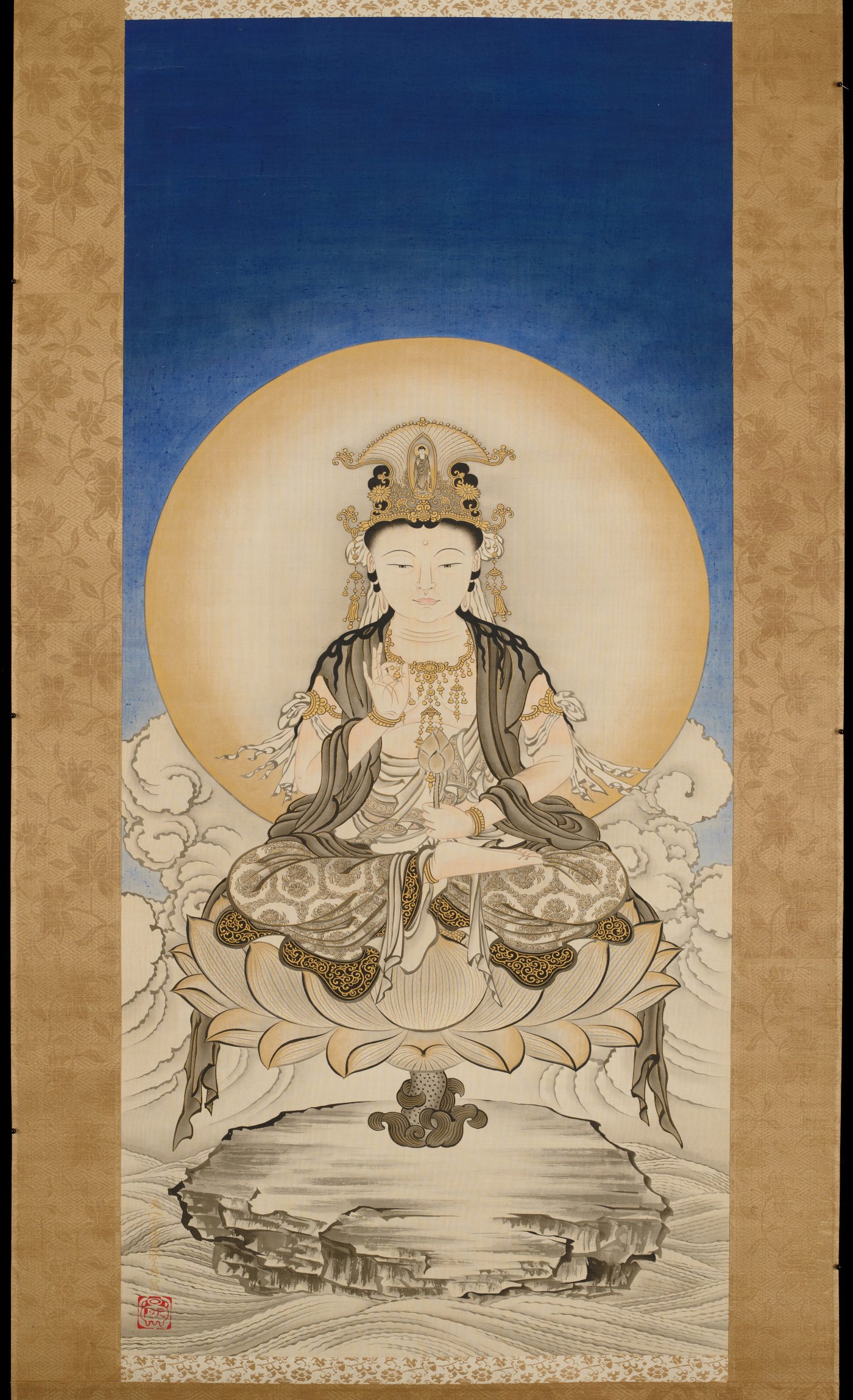
Arguably, one of the most well known and most recited chapters of the Lotus Sūtra is Chapter 25, “The Universal Gateway” (Fumon-bon 普門品), aka “Universal Gateway of the Bodhisattva Perceiver of the World’s Sounds” (Kanzeon-bosatsu-fumon-hon 観世音菩薩普門品), aka the “Avalokiteśvara Sūtra” (Kannon Gyō (観音経), despite not being a standalone sūtra. It’s not difficult to see how Avalokiteśvara become so loved in Mahāyāna Buddhism. There are roughly 10-15 standalone sūtras dedicated to Avalokiteśvara, over 5 larger sūtras with a section dedicated to Avalokiteśvara (such as the Lotus Sūtra), and then over 20 ritual texts dedicated to Avalokiteśvara. This talk will try to focus on Chapter 25 of the Lotus Sūtra, but will also include elements from other texts to help support this talk.
STRUCTURE – Prose and Verse 散文–偈頌
Chapter 25 begins in a typical way that we see in most Buddhist sūtras. First, we have an opening prose (gadyam, 散文) that sets the scene. Usually, sūtras would start with “Thus have I heard, at one time the Buddha was….”, followed by giving further details such as a location and an audience, but as previously stated, this is a chapter of the Lotus Sūtra, so these are absent. However, we do begin with the Bodhisattva Akṣayamati (Inexhaustible Awareness 無盡意菩薩) asking the Buddha why Avalokiteśvara is called Avalokiteśvara. The Buddha answers this by giving numerous examples of how Avalokiteśvara appears in numerous different ways and manifestations to anyone who calls upon him/her, as Avalokiteśvara hears everyones pleas. Here, Avalokiteśvara is presented akin to a kind of saviour. The imagery can be quite fanciful too, with examples of beings being able to walk through fire without being harmed, swords and other weapons shatter into pieces when struck by them, and chains broken to pieces when we are falsely imprisoned, etc. The Buddha then recounts the various forms that Avalokiteśvara can appear as, which covers everything from gods, goddesses, to humas, nāgas, yakṣas, asuras… – essentially as any form of being (in other sūtras, this includes non-animate objects too) known as the 33 Forms (三十三身, Sanjūsanshin).
The Buddha then repeats this in the form a verse (padya, 偈頌 / 偈句). This repetition of the prose and verse is typical of sūtras, especially Mahāyāna ones. Some scholars have speculated that the verse sections are the “earlier” sections of the sūtra, and that the prose section was added at a later date to add further detail. The verse section is written in a mnemonic/poetic style that is often missing in the prose section. Many early or smaller/short sūtras are often written entirely in this mnemonic form as it aids in both memorisation and recitation. When we recite chapters of the Lotus Sūtra it is these verse sections that we usually recite. Some translators have tried to recreate a poetic form of the verse section in their translation, however this can sometimes lend to a more creative translation, rather than a critically correct one.
THE NAME – Avalokiteśvara
What sparks the discourse in this chapter is the name of Avalokiteśvara. In Sanskrit, we can break down the components of the name;
- ‘Ava’ – meaning ‘down’
- ‘lokita’ – meaning ‘to look, notice, observe’
- ‘Īśvara’ – meaning ‘lord, ruler, master’
This gives us a rough translation of ‘Lord who looks down’. In Chinese this was translated as 觀自在 Guānzìzài (Kanjizai). However this is different to the more popular 觀世音 Guānshìyīn (Kanzeon), which is often abbreviated to Guanyin/Kannon 觀音. Scholars had previously speculated that the reason for this difference was due to a possible misunderstanding of the Sanskrit by early translators, who mistook Avalokiteśvara (‘Lord who looks down’) for Avalokitasvara (‘Lord who looks upon sound [of the world]’) making the Chinese translation 觀世音 (roughly translated into English as ‘Observer of the sounds of the world’), as ‘lok’ was taken to have a dual meaning of ‘look’ and ‘world’. This also appears in another name for Avalokiteśvara; ‘Lokeśvara’, which means roughly ‘Lord of the world’. However, the name Avalokitasvara actually appears in the earliest known texts to mention Avalokiteśvara, which also includes early renditions of the Lotus Sūtra. This, then, tallies up with Kumārajīva’s translation of the Lotus Sūtra, in which Avalokiteśvara’s name appears as 觀世音 Guānshìyīn/Kanzeon (‘Lord who looks upon sound [of the world]’), which suggests that Kumārajīva was translating an “early” form of the Lotus Sūtra, possibly a Prakrit rather than Sanskrit text. This difference in the name also casts doubt on the idea that Avalokiteśvara was borrowed into Buddhism from Hinduism, as the name ‘īśvara’ is used for Shiva and Vishnu, and are considered ‘Rulers of the World’. This theory doesn’t work for the earlier name ‘Avalokitasvara’;
- ‘Ava’ – meaning ‘down’
- ‘lokita’ – meaning ‘to look, notice, observe’
- ‘svara’ – meaning ‘sound, voice’
This rendition of the name also makes more sense in the context of the 25th Chapter of the Lotus Sūtra, as Avalokiteśvara is said to come to the aid of anyone who calls upon him/her, suggesting he/she is listening to the sounds of our pleas. It is this rendition of the name that Zhiyi bases his commentary on.
CORE THEMES
- Compassionate action – Avalokiteśvara is synonymous with compassion in the hearts and minds of Buddhists. In this chapter, we see how Avalokiteśvara brings immediate aid to everyday crises, such as shipwrecks, illness, imprisonment, childbirth, warfare, famine, and many others)
- Universal compassion – Avalokiteśvara doesn’t make a distinction between gender, age, race, sexuality, or social status. He/she comes to the aid of anyone who calls upon him/her, reinforcing the Lotus Sūtras claim that the Dharma is for all.
- Skilful means – The many ways in which Avalokiteśvara appears and helps sentient beings, illustrates how there is no one “right way”, but a right way for the right time, place, and circumstance.
The prevailing view of this chapter focuses on the miraculous and salvific powers of, not just the Bodhisattvas, but by implication, also the various Buddhas. Equally, what should not be overlooked is how we can apply these core themes to our own practice;
- Compassionate action – throughout Buddhist literature and practice, compassion is often spoken of in terms of meditations, mantras, and other cultivation practices. Here, this chapter illustrates how we can apply compassion in various different ways which aren’t tied to “religion” or proselytising a particular view or doctrine.
- Universal compassion – our acts of compassion should not come with judgment of who is deserving and who isn’t. This sounds simple but is actually incredibly difficult in practice. First we tend to give preference to those we “like”, such as family members or friends. Then we give preference to those whom we agree with, those who have similar likes and dislikes to us. And this continues in a strange sort of hierarchy that we create ourselves. Furthermore, the idea of universal compassion raises questions of how to treat those who hurt others, such as criminals and/or abusers. How can we treat those people with “equal” compassion to those who are kind, and follow the law. This leads to the next core theme of this chapter…
- Skilful means – in this chapter, Avalokiteśvara appears in different ways dependant on the people and circumstance. This illustrates how universal compassion does not mean treating every issue with the same answer. Each circumstance is unique, just as each individual is unique. For this reason, the way in which we show compassion to a criminal will be different to the way we show compassion to a law-abiding citizen. Furthermore, each criminal is treated differently, and we can see this in action in our courts. People often criticize our legal system as two people who commit the same crime might receive different sentences. This is because the courts try to take into account numerous different facts about the case to come up with an appropriate sentence, such as family backgrounds, education, mental health, the various motivations for the crime, personality traits and much more. Of course, this example is flawed because we, as unenlightened beings, are flawed. Courts often get it wrong. This is why, when using skilful means to apply compassion must be in conjunction with wisdom. The various Buddhas and Bodhisattvas have wisdom, but we might not. This is why practice and striving to achieve the path is important. Wisdom and compassion are two sides of the same coin, just as study and practice are.
MALE OR FEMALE?
By now you’ll have noticed that I have been using the pronouns “he/she” when referring to Avalokiteśvara. I should point out that in the Lotus Sūtra, Avalokiteśvara is presented as male, with male grammatical forms and pronouns. This was also the standard form of Avalokiteśvara in India too, with many early artistic depictions in the Gandhara period (2nd-3rd century CE) showing Avalokiteśvara with facial hair. Despite this, Avalokiteśvara, and other Bodhisattvas, slowly began to be depicted as more feminine or more correctly, as androgynous. Facial hair was dropped in favour of soft, gentle facial features, their waists thin with a slight hint of a bosom. With the arising of Tantra we start to see full female forms of Avalokiteśvara in both art and literature. The feminisation of Avalokiteśvara also grew popular in China. It is often speculated that the early Chinese had trouble visualising the soft gentle nature of Avalokiteśvara as anything other than female, with the full female form of Avalokiteśvara becoming more popular, as found in countless folk tales. It is more likely, however that the figure and stories of Avalokiteśvara was blended with local stories of various goddesses or female heroines. Whatever the case, it should be noted that the male form of Avalokiteśvara is also found in China. This gender fluidity is also found in the Lotus Sūtra itself, as Avalokiteśvara is said to appear as either male or female. Zhiyi noted that compassionate action “has no gender”.
CRITICAL HISTORY
Scholars have long suggested that this chapter was an addition to the Lotus Sūtra, believing there to be three or four “stages” to its construction, with chapter 25 coming in at the last stage, at around 150 CE. The reason they believe this is mostly due the terminology, syntax, and a formulaic style that makes it stand out from the main body of the Lotus Sūtra. For these reasons, and others, scholars have debated whether this chapter was either part of a different sūtra, or perhaps was its own standalone sūtra, and then added to the Lotus Sūtra at a later date. This contrast with the core of the Lotus Sūtra was not missed by masters of the past, including Zhiyi, who classed this chapter as part of the “Revelation of the Power and Function of the Bodhisattvas” (菩薩神力顯德分) section of the Lotus Sūtra, fitting into a ‘Three Body’ (trikāya) view of the Lotus Sūtra, in which the Nirmāṇakāya, Shakyamuni, preaches the first fourteen chapters, known as the “trace teaching” (shakumon 迹門) in which the Buddha reveals teachings such as the ekayāna (One Vehicle), then the Dharmakāya preaches the “fundamental” or “origin teaching” (honmon 本門) which reveals the true nature of the Buddha, and then the “Revelation” sections (chapters 23, 24, 25, 26 & 27) represents the “Sambhogakāya” and the Buddhas compassion, or rather the manifested “function”.
TRADITIONAL COMMENTARIES
Naturally, due to the popularity of this Chapter, there are numerous commentaries from different schools and times in history. The traditional Tendai commentaries on this chapter include Zhiyi’s ‘Profound Meaning of the Universal Gate of Avalokiteśvara’ (觀音菩薩普門品玄義), ‘Words and Phrases of the Universal Gate Avalokiteśvara’ (觀音菩薩普門品義疏), and Genshin’s ‘Notes on the Merits of the Avalokiteśvara Sūtra’ 観音經功徳鈔 (Kannon-kyō Kudokushō).
 Tendai Buddhism UK