Kṣitigarbha Bodhisattva saving (sentient beings) in the Six Realms
六道 Rokudō means the Six Realms of Rebirth (in Samsara)
能化 nōge invokes the ability or power to cause change
六道能化地藏 Rokudō nōge Jizō, therefore, gives us the impression that Kṣitigarbha Bodhisattva (Jizō Bosatsu 地藏) is able to change the fate of those trapped in the realms of Samsara. He does this by traversing the various realms, bringing the Dharma to all sentient beings without prejudice. Each of the Six Realms is assigned its own manifestation/depiction of Kṣitigarbha Bodhisattva, known as the Six Kṣitigarbha (Roku Jizō 六地蔵).
These depictions date to at least the 11th century, and is believed to be based on the earlier tradition of the Six Avalokiteśvara (Roku Kannon 六観音, based on Zhiyi’s teachings), but are also based on the Jizō Ten Kings Sūtra (地蔵十王経, aka Jizō Bosatsu Hosshin In’nen Jū-ō Kyō 地蔵菩薩発心因縁十王経), which although was believed to come from China, scholars now suggest it was written in Japan, although based on an earlier text on the Ten Kings of Hell.
There are two main versions of the Six Kṣitigarbha and are described below, although there does exist others versions/names, etc.

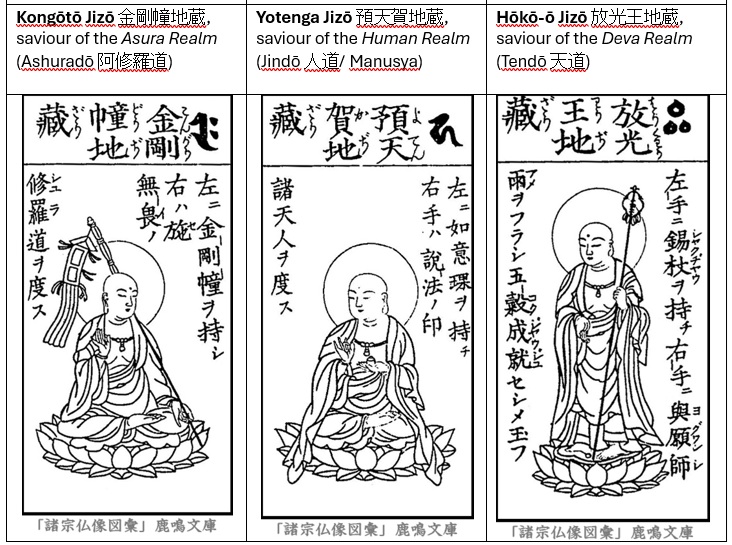
(Images taken from http://rokumeibunko.com/butsuzo/bosatsubu/b02703_rokujizo.html)
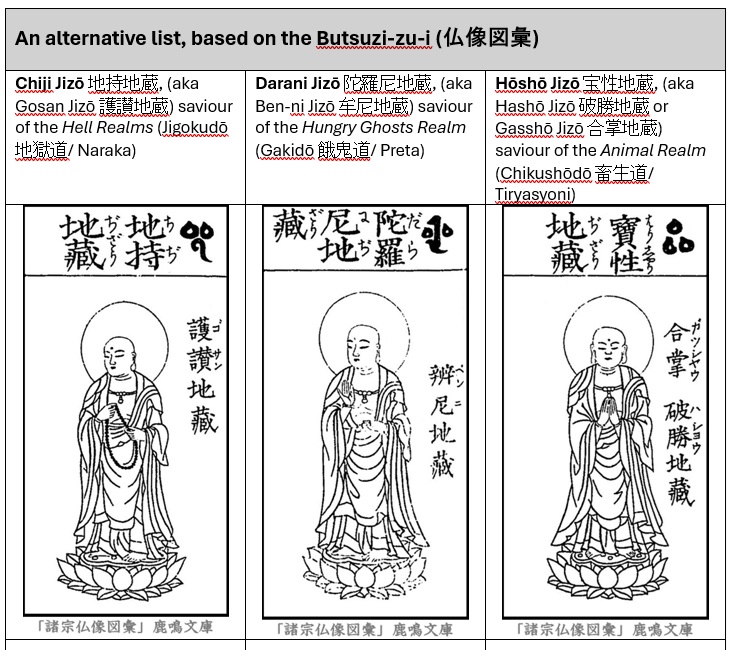
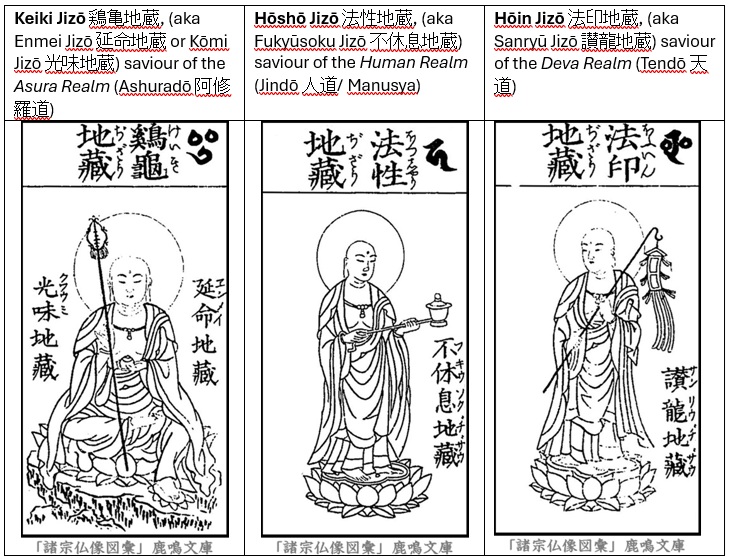
(Images taken from http://rokumeibunko.com/butsuzo/bosatsubu/b02703_rokujizo2.html)

If you go to temples and cemeteries in Japan, you will see these images, and numerous other depictions of Jizō, often with red bibs and bonnets. This is because in modern Japan Jizō is primarily associated with the protection of children who have died tragically young, or from miscarriage, stillbirth, or abortion. It is believed that these young children are then guided by Jizō to a better rebirth.
Seeing all those images evokes a strong sense of sadness for all those who’s lives were cut short, and for the grieving parents. In Japan, they are called ‘water babies’ (mizuko 水子), stemming from the amniotic fluid. This is a much better name, as often the child dies so young that the parents don’t have a name. It’s so much better than calling the baby ‘it’. I also really like how parents are able to go to temples and seek solace, not judgment, for the loss of a child, and most importantly acknowledgement.

In the west, when a mother miscarries, she is often viewed as a statistic, and the baby she was carrying was only a “clump of cells”. However, in Japan they are given a space to acknowledge the life lost and grieve. When my wife and I lost our first child due to miscarriage, I was able to find solace through Jizō Bosatsu.
There is a poem about a mythical place called Sai no kawara (賽の河原) a sort of place of limbo in which young children are made to stack stones on the river, and then Jizō comes to save all those children. Although the story in the poem is not based on Buddhist sutras, this poem is often recited during the Mizuko kuyō – a service dedicated to mizuko (water babies). This one section of the poem really touches me;
その時能化の地蔵尊 われを冥途の父母と
“Then appears the merciful Jizō Bodhisattva,
Saying “I shall be your father and mother in the land of the dead”,
思うてあけくれ頼めよと 幼き者をみ衣の
“Rely on me, morning and night,” he says,
And gathers the little ones
裳裾のうちにかき入れて 憐れみ給うぞありがたき
Into the folds of his sacred robe,
Compassion overflowing – how grateful we are.
未だ歩めぬみどり児を いだきかかえてなでさすり
He holds those too young to walk,
Cradling them gently, soothing them with care.
憐れみ給うぞありがたき 南無阿弥陀仏
With boundless mercy – how grateful we are.
Namu Amida Butsu.”
I hope, if any parent is going through the same thing they too can find solace through Jizō.
With thanks to Kansei David for the photos
 Tendai Buddhism UK